It's no longer optional
90% of developers use at least one AI tool at work (JetBrains, January 2026). 51% use it daily. We're past the exploration phase — now it's a matter of whoever isn't using it already being behind. GitHub Copilot leads with 29% workplace adoption and over 26 million users, while Cursor and Claude Code are tied at 18% each.
But adoption alone isn't the full story. Individual productivity rises 21%-55% with AI assistance, but organizational delivery stability decreases without solid engineering foundations (DORA 2025). AI amplifies what already exists — if practices are good, it accelerates them; if they're poor, it accelerates the problems.
Where AI already delivers measurable value in the SDLC
Data consistently shows AI delivers quantifiable value on repetitive, well-defined tasks across the SDLC: planning, code generation, testing, and maintenance. Here's the breakdown by phase:
Code generation. GitHub Copilot generates on average 46% of code written by its active users, reaching 61% in Java. Google reports over 25% of its new code is AI-generated, and Microsoft between 20-30% in active projects — but everything passes human review before production. The documented average savings: roughly 3.6 hours per week per developer.
Testing. AI assistants generate unit and integration tests from existing code logic. Full test suite generation has been documented in benchmarks at around 23 minutes — tasks that manually took hours or days. This doesn't replace testing-strategy design, but it eliminates the mechanical work of writing cases.
Documentation. AI tools produce documentation such as API descriptions, onboarding guides, and code comments directly from source code. What used to go undocumented "for lack of time" is now generated as a byproduct of development — the problem flips: it's no longer about creating documentation, but reviewing it.
Estimation and planning. Generative AI transforms ideas into requirements, turns those requirements into user stories, and generates test cases, code and documentation. In planning, models can analyze sprint history and code complexity to inform estimates — not replacing the team's judgment, but giving it data it didn't have before.
What the productivity numbers don't say
There's a flip side vendor reports don't highlight:
More code isn't more value. Code churn (code discarded within the first two weeks) rose from 3.3% in 2021 to 5.7-7.1% in 2026-2027. More lines faster doesn't mean more working software — it means that without rigorous review, AI produces disposable code.
Quality needs attention. Independent analyses found roughly 1.7× more issues in pull requests co-written with AI. Without new code-review patterns and quality automation, AI can increase technical debt instead of reducing it.
The real ROI isn't 10x. Healthy ROI for AI development tools averages 2.5-3.5x, with top-quartile organizations reaching 4-6x. It's not the 10x the marketing promises, but it's still positive — if managed well. Costs are no longer trivial: agentic tools like Claude Code cost between $200-$2,000+ per engineer per month in tokens, bringing total cost per engineer to $200-$600/month on average.
From copilot to AI-native SDLC
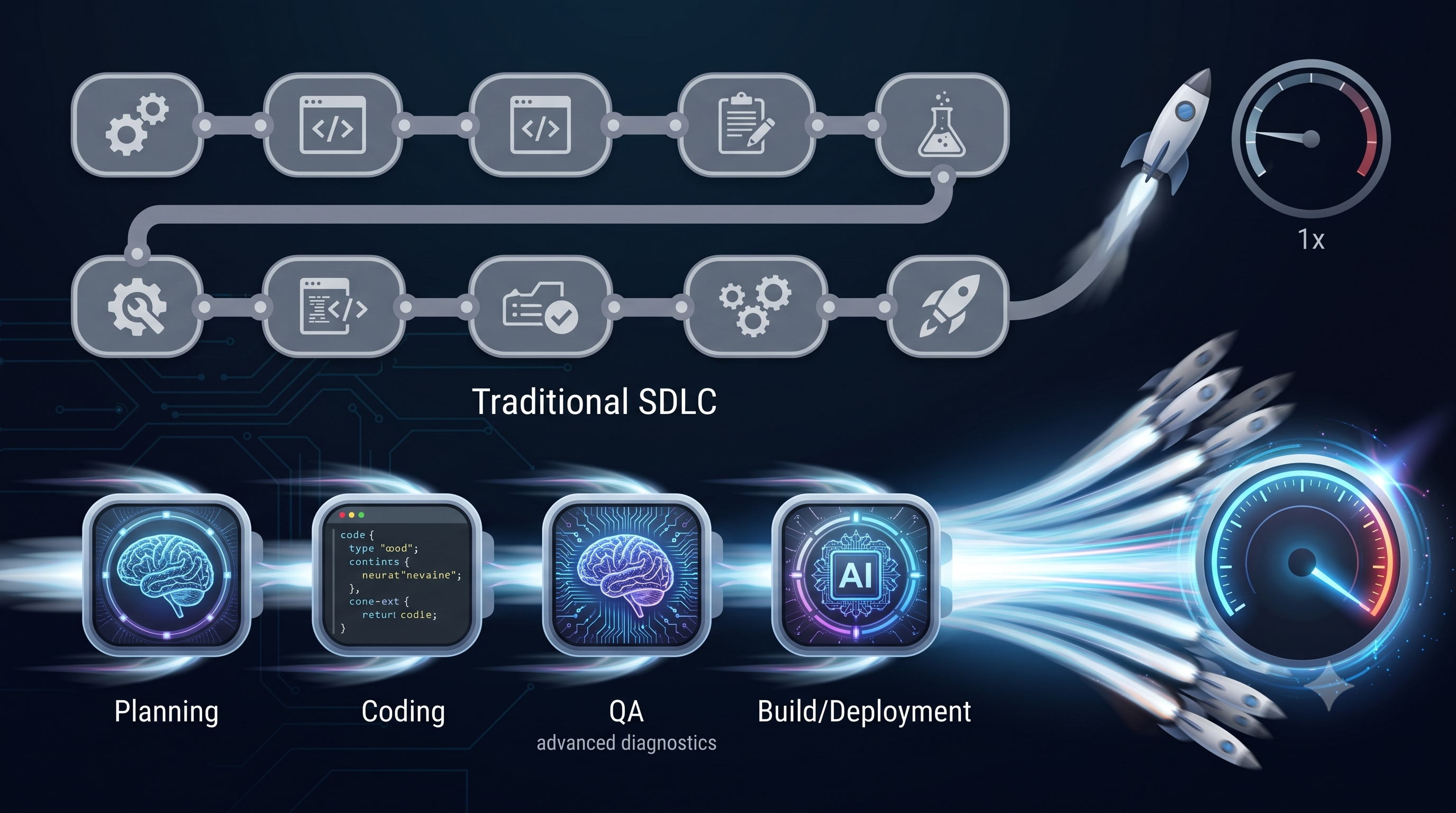
Most organizations today use AI as sophisticated autocomplete inside a traditional development process. A truly AI-native SDLC implies a deeper shift, where every stage of development — from product discovery to operations — relies on AI systems, creating an ecosystem where humans and intelligent agents work in continuous collaboration flows.
AI agents act as an intelligent layer that boosts productivity, reduces cognitive load, and improves decision-making, turning the SDLC into a more adaptable, efficient, iterative process. The shift underway — already happening — is moving from "the developer uses an AI tool" to "the team operates with AI agents integrated into every stage of the cycle".
What an organization needs to do this well
Governance before speed. AI creates risk when teams skip defining what AI can and can't decide, applying quality standards to generated output, and setting cost controls before rollout.
Non-negotiable human review. None of the companies reporting positive results (Google, Microsoft, Shopify, Mercado Libre) send AI-generated code directly to production — everything passes human review.
Solid engineering practices as a prerequisite. A team with strong engineering practices will get disproportionate value from AI tools. A team with poor practices and accumulated technical debt may find that AI accelerates those problems before fixing them.
Measure what matters. Not lines of code generated, but cycle time (commit to production), defect rate, code churn, and total cost per engineer including tokens.
The real question
It's not whether your team should use AI in the development cycle — that's already settled. The question is whether it's being used in a way that accelerates value delivery without degrading quality, or whether it's simply producing more code faster that nobody reviews, nobody documents, and nobody maintains.
Sources: Stack Overflow Developer Survey 2025 (65,000+ devs), JetBrains AI Pulse January 2026 (10,000+ devs), Google DORA 2025 (10,000+ respondents), Larridin Developer Productivity Benchmarks 2026, GitClear Code Quality 2025, GitHub/Accenture Enterprise Research, Anthropic Economic Index 2026, CodeRabbit 2025.
 Qi-Vanta
Automation and artificial intelligence for businesses. From discovery to production, with measurable ROI.