Context
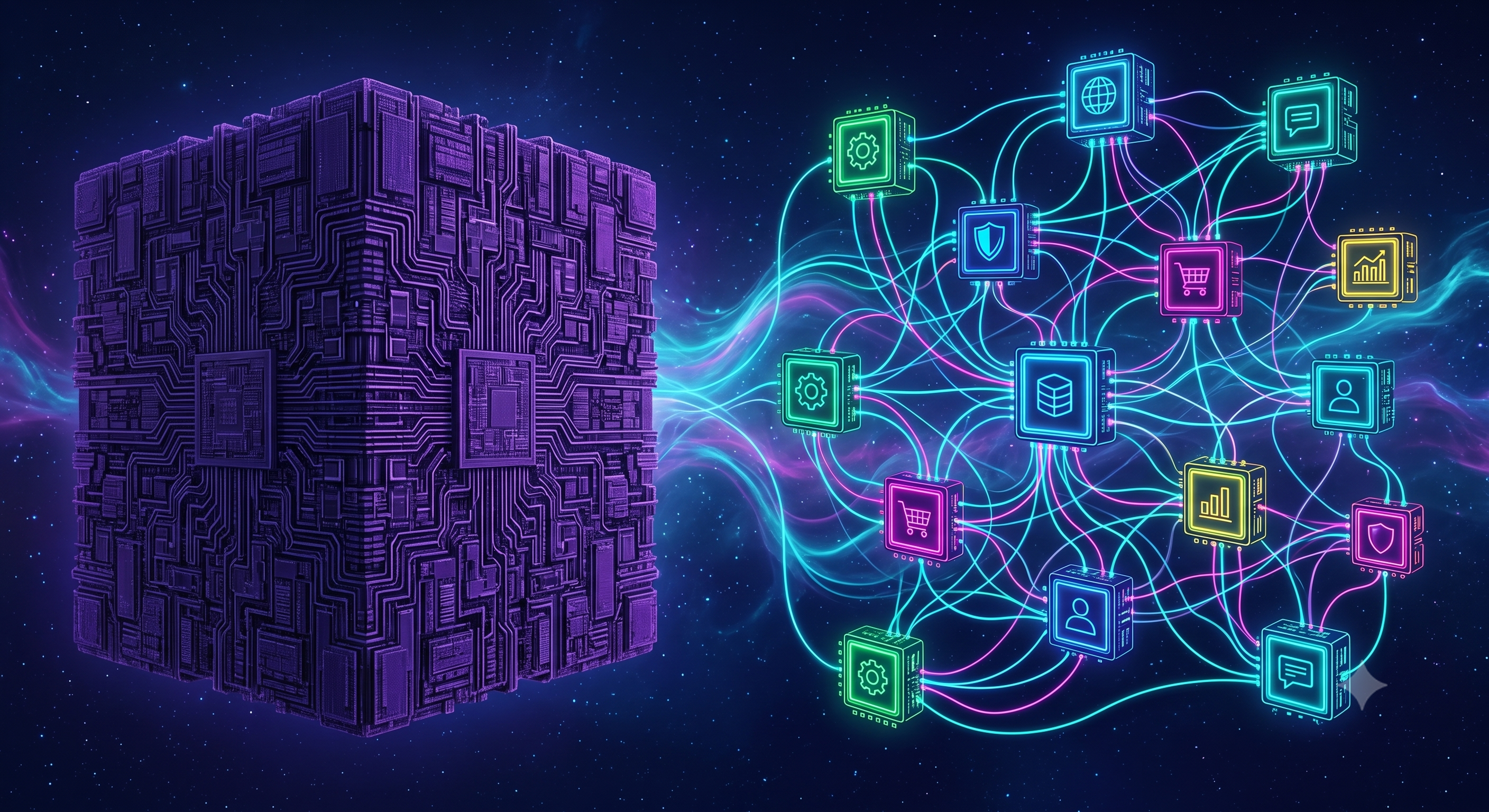
Aseguradora Continental Mexico runs its policy-issuance and claims core on a Java monolith (version 8) over 12 years old, with nearly 2.8 million lines of code in a single repository. The system is critical — running 24/7, managing policy issuance, premium calculation, and claims management — but every deployment required a nighttime maintenance window and any small change needed full regression testing.
The challenge
- 3-4 week deployment cycles for any change, even minor tweaks.
- One large team, no clear module ownership — any developer could break unrelated functionality.
- Implicit dependencies and hidden coupling between the issuance and claims modules, undocumented.
- Java 8 at the end of its extended support cycle, with libraries carrying known vulnerabilities with no available patch.
- High risk of a "big bang" migration: the system couldn't stop or degrade during the process.
The solution: incremental modernization with the Strangler Fig pattern
Instead of a full rewrite, the team adopted a gradual extraction strategy, backed by AI tools to speed up legacy-code analysis.
APPROACH
- AI-assisted dependency mapping: before touching code, a real coupling map of the monolith was generated (not the documented one, the one actually existing in the code), identifying which modules could be extracted first with the least risk.
- Strangler Fig pattern: an API Gateway was placed in front of the monolith; each business capability (quoting, issuance, claims management, billing) was extracted one at a time as a Java 21 microservice, gradually redirecting traffic without shutting down the original system.
- Low-risk first: started with customer-facing features (policy status inquiry, notifications) to gain experience before touching the transactional issuance core.
- Assisted code generation: for lower business-complexity modules, an AI assistant generated the microservice's base scaffold (OpenAPI contracts, Spring Boot skeleton, initial unit tests), always with human review and approval before integration — no generated code went out without a senior developer's validation.
- Data: each microservice adopted its own database; synchronization with the monolith during transition via Change Data Capture (CDC), avoiding error-prone dual writes.
- Asynchronous messaging: events via Kafka between extracted services and the remaining monolith, to decouple without breaking business consistency.
Results at 10 months
| Metric | Before | After |
|---|---|---|
| Deployment frequency | Every 3-4 weeks | Several times a week |
| Cycle time (commit to production) | ~18 days | ~2 days |
| Production incidents per deploy | Base 100% | -54% |
| Modules extracted as microservices | 0 | 7 of 12 domains |
| Automated test coverage | 22% | 68% (extracted) |
The system never stopped operating during the transition; modules not yet extracted still run in the monolith, now isolated behind the API Gateway, without blocking progress on the rest.
Key success factors
- Never "big bang" — the Strangler Fig pattern allowed progress without risky maintenance windows or stopping the business.
- Start with the lowest risk to build confidence before touching the transactional core.
- AI as an analysis and scaffolding accelerator, not a replacement for human judgment — all dependency mapping and generated code went through architect and senior-developer review.
- Explicit API contracts (OpenAPI) from the first extracted service, avoiding recreating the monolith's hidden coupling in the new architecture.
Lesson to replicate
Modernizing a critical system isn't won by rewrite speed, but by reducing the risk of each step — extract, validate, deploy, repeat — with AI tools accelerating analysis and scaffolding, but never replacing human validation on a system the daily business depends on.
 Qi-Vanta
Automation and artificial intelligence for businesses. From discovery to production, with measurable ROI.